
Born in the Saddle: Hermès’ Equestrian Origins
Hermès began as an equestrian atelier long before it was a global fashion powerhouse. In 1837, founder Thierry Hermès opened a workshop in Paris crafting handmade harnesses, bridles and saddles for Europe’s nobility . His superior leather craftsmanship quickly earned him a reputation as the premier harness-maker for horse-drawn carriages in Paris . At a time when horses were the main mode of transport, Hermès supplied the elite with finely wrought tack – even Napoleon III and Empress Eugénie were early patrons, cementing the house’s prestige . The brand’s emblem to this day, a horse drawn carriage, harkens back to this origin. As one luxury analyst noted, Hermès’ early identity was deeply tied to the “golden age of the horse,” and its artisanal prowess in saddlery would form the DNA of the brand .
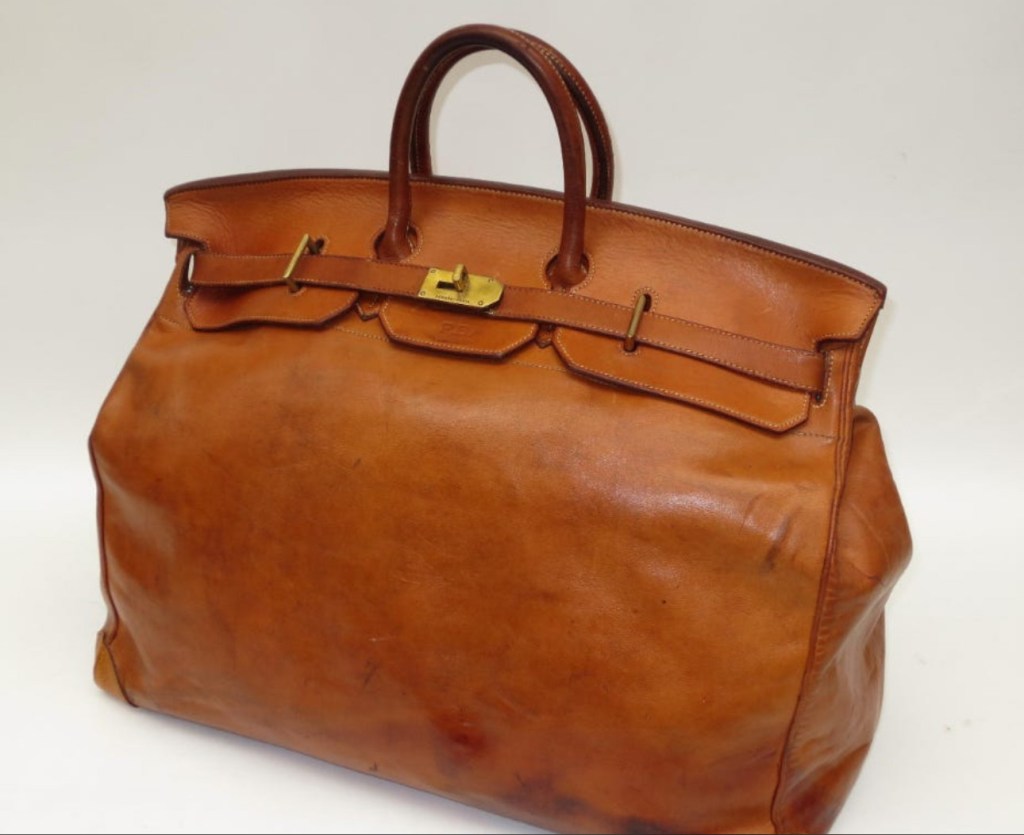
Key milestones of Hermès’ equestrian legacy dot its early timeline. In 1880, the family moved the shop to 24 Rue du Faubourg Saint-Honoré , the same address as today’s flagship, complete with an upstairs workshop for saddlery . By 1900, Hermès debuted the Haut à Courroies bag (or “HAC”), a tall leather holdall “meant for riders to carry their saddles” and riding boots . This clever product extended Hermès’ reach from horse to rider, offering a way for equestrians to transport gear in style. Little could Thierry Hermès have known that this utilitarian horseman’s bag would evolve into the template for the iconic Birkin and Kelly handbags decades later . But already, more than a century ago, we see the seeds of Hermès’ transition: serving not just the horse, but the elegant lifestyle surrounding it.
Changing Gears: Adapting Beyond the Carriage Age
As the 20th century arrived, the world of transportation underwent seismic change, and Hermès had to adapt or risk obsolescence. With the advent of the automobile after World War I, the demand for horse tack dwindled. Émile-Maurice Hermès, a grandson of the founder, foresaw that “the car would replace the horse as the primary mode of transportation,” and that Hermès “needed to…capitalize on this looming shift.” This forward-thinking vision sparked an evolution from a saddle-maker into a broader luxury house. In 1919 Émile-Maurice bought out his more traditional brother Adolphe, determined to diversify beyond the equestrian niche . Legend says he rallied the Hermès craftsmen and posed a pivotal question: “What can we make with our hands here that will interest our clients today?” The answer would unfold in a range of new products targeting the lifestyles of the modern elite.
During the 1920s, Hermès aggressively expanded its offerings, using its leatherworking savoir-faire to cater to the new age of luxury travel . In 1922, responding to his wife’s complaint about the inconvenience of the tall HAC bag in a car, Émile Hermès introduced a smaller handbag designed for automobile travel . This innovation effectively launched Hermès’ handbag business, marking the company’s formal evolution from “equestrian outfitter to purveyor of luxury accessories.” No longer would Hermès serve only riders and horses, now it would outfit travelers, drivers, and the cosmopolitan jet set. By 1925, Hermès travel bags and trunks (outfitted with newfangled zippers Émile had discovered in America) were a global success . The company introduced its first leather garments as well, such as a zippered leather golf jacket for the Prince of Wales in 1918 – symbolically dressing the gentleman, not just his horse.
Hermès also branched into fine accessories during this era, often at the urging of clients who loved the brand’s quality. One apocryphal tale recounts a loyal client jesting that he was “fed up with seeing my horse better dressed than me,” prompting Hermès to start a clothing line . Whether or not that quip was true, the 1920s did see Hermès add wearable collections: belts, jackets, jewelry (in 1927), watches (1928), and more . Silk scarves (carrés), which would become a maison signature, debuted in 1937, emblazoned with bridle and horse-motif prints that paid homage to the house’s heritage. And in 1935, Hermès released a new handbag originally called the Sac à dépêches, a refined leather purse that two decades later, would be nicknamed the “Kelly bag” after actress turned princess Grace Kelly, who famously carried it . Hermès was no longer just a saddler; it had reinvented itself as a luxury lifestyle brand, albeit one that still infused equestrian flair into its designs. As one fashion historian observed, the house’s “prowess in saddlery” simply paved the way for “excellence in leather accessories” as Hermès pivoted to meet the modern world .
Heritage in Handbags: From the Kelly to the Birkin
Even as Hermès diversified, it never completely severed ties with its riding legacy, instead, it repurposed that heritage into the design of its most famous accessories. Many of Hermès’ iconic bags and motifs have direct equestrian inspirations. The Kelly bag, for example, features a leather strap and buckle closure derived from saddle girths and straps (a design rooted in function that gave it timeless form). The Birkin bag, introduced in 1984, likewise carries subtle horsey hallmarks: its sturdy rectangular shape and flap were adapted from the HAC saddle bag, and its leather straps with metal lock closures evoke the straps of a riding harness. Hermès chairman Jean-Louis Dumas created the Birkin for actress Jane Birkin after a chance encounter on a Paris-London flight, deliberately infusing it “with equestrian elements” to give it that signature Hermès look . The result was a bag that married practical craftsmanship with refined style, much like a great saddle , and it became an instant classic.
By the late 20th century, handbags like the Kelly and Birkin had eclipsed saddles as Hermès’ most celebrated products. The Birkin in particular turned into a cultural phenomenon: a status symbol so sought after that owning one confers a certain cachet. It “quickly became a symbol of wealth and exclusivity” with reputed waitlists and limited supply . Indeed, over the past decade, the resale value of Hermès Birkin (and Kelly) bags has outpaced gold as an investment, according to luxury experts . This transformation of a humble carryall into a financial asset underscores how far Hermès has traveled from its utilitarian origins. As Hermès expert James F. Firestein noted, before the Birkin craze Hermès was “a subtle old-money brand” prized for quiet craftsmanship, but the Birkin propelled it into pop culture as the ultimate “it bag” maker . In essence, the house built on horse tack became the house of the handbag. And yet, the ghost of the horse still haunts these luxury leather goods: from the saddle stitching used to sew every bag, to signature details like the metal feet (clou de selle) on a Birkin that echo a saddle’s studs, Hermès’ equestrian DNA quietly endures in its craftsmanship.
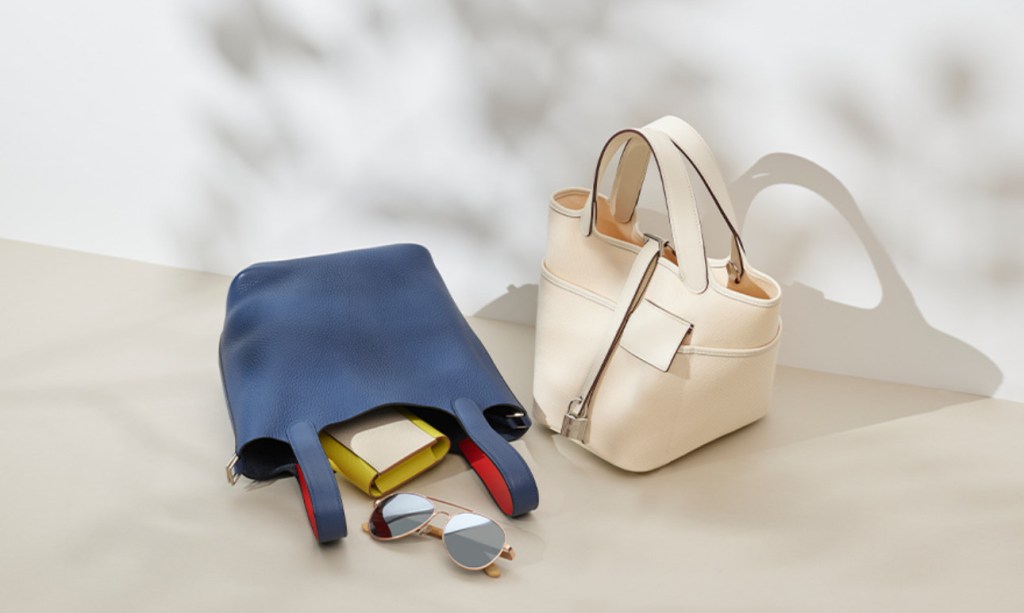
Contemporary Hermès handbags still wink at the brand’s riding heritage. The cream colored Picotin Lock bag ( Right) was named after a unit of horse feed and inspired by a horse’s feed bag . The casual Evelyne bag (blue, left, shown open) was originally designed in 1978 as a groomer’s tool bag with a perforated ‘H’ for ventilation .
Indeed, many modern Hermès accessories have origin stories tied to the stable. The Picotin Lock, first released in 2002, takes its name from the French word for a measure of grain, and its bucket shape and strap were modeled after a horse feed bag . The popular crossbody Evelyne bag was invented by Hermès’ own riding department head in 1978 as a carryall for horse groomers, its ventilated perforated “H” logo was meant to let damp brushes dry, and its canvas strap was inspired by a saddle girth . Even whimsical bag charms like the leather Rodeo horse charm nod to the equestrian theme . The house’s famed silk scarves frequently feature horse prints, reins, and carriages. In this way, Hermès has woven its equine heritage into the fabric of its luxury goods, offering products that feel classic, stable (so to speak), and rooted in a narrative of craftsmanship. This storytelling has been powerful , it allows a Birkin or silk carré to carry an aura of tradition and authenticity, even as most customers use these items far from any riding ring.
Yet for all these references, there is a growing sense, especially among equestrians that Hermès today is Hermès in name only when it comes to the horse world. The brand’s identity has tilted so heavily toward high-fashion accessories and prêt-à-porter that its original raison d’être (serving actual riders) has been relegated to the sidelines. Luxury commentators have observed that many heritage houses, Hermès included, “have swapped their core DNA in favor of the numbers.” In other words, the pursuit of growth and profit (through handbags, watches, sneakers, and perfume) has gradually outpaced the more niche equestrian tradition that built the brand’s name. Nowhere is this contrast more apparent than in Hermès’ financial breakdown: the company still quaintly labels its largest business segment “Leather Goods and Saddlery,” but in truth that category – which comprises about 50% of Hermès’ revenue, is overwhelmingly driven by handbags and small leather accessories, with saddles being only a minuscule (if symbolic) fraction . Hermès proudly maintains its saddler workshop in Paris and keeps a handful of master saddle-makers on staff, but these days they serve a tiny elite clientele (bespoke saddle orders, often for show-jumpers or wealthy hobbyists) rather than the broad base of the business.
Losing the Reins: Signs Hermès Is Drifting from Its Horsey Heritage
To the dismay of many equestrians who love the brand, recent signs indicate that Hermès is quietly phasing out some of its classic riding products. Nowhere is this more evident than in footwear. For decades, Hermès offered exquisite riding boots, the kind of tall leather field boots suitable for jumping or dressage, befitting its pedigree. But in 2023, a lifelong rider looking to purchase Hermès tall boots got a surprise: “I was informed that Hermès no longer makes tall riding boots [for jumping or dressage]. They currently only offer paddock boots, and even those are being phased out of the equestrian line with limited sizing available,” the equestrian reported, calling it “a bit disappointing considering the brand’s rich equestrian heritage.”The sales associate at Hermès candidly recommended the customer turn to specialist brands like Vogel or Fabbri for serious competition boots. In a separate correspondence, an Hermès representative confirmed the news: “In our equestrian line we offer paddock boots but…the sizing is limited since they are being phased out”, she wrote, even volunteering to send a catalog of remaining options. For formal horse shows, the Hermès associate suggested checking out other makers because “you will need a tall boot” and Hermès doesn’t have one, “Hermès won’t bother,” as one frustrated commenter put it.
This revelation landed with a thud in the equestrian community. To long-time Hermès aficionados, the idea that the house no longer produces a proper riding boot, a staple of its product line in years past, feels almost sacrilegious. “This is wild to me,” one rider lamented on social media. “When I was in Venice about 10 years ago, the Hermès main display was horse dressage. This is sad.”The contrast is striking: a decade ago Hermès stores proudly showcased saddles and riding attire in their windows, reinforcing the brand’s equine bona fides; today, a customer walking into most Hermès boutiques would be hard-pressed to find a single stirrup or boot amidst the sea of Birkins and silk scarves. In fact, several enthusiasts have observed that even smaller equestrian accessories are becoming scarce. “It seems like as of late Hermès is producing fewer and fewer equestrian goods,” noted one dressage rider, “They’ve phased out a number of colors of the saddle pad and don’t even make a [riding] jacket anymore. Such a bummer!”. Where once Hermès sold everything from riding coats to crops to horse blankets (in that iconic orange), now those offerings are limited or discontinued. The equestrian collections have largely shrunk to a token assortment: a few saddle models (custom-made to order), some saddle pads and polo wraps, maybe a grooming kit or a riding helmet in select flagship stores. These items are often absent from store shelves and only available via special request or at the Paris mothership. For everyday riding apparel or boots, even wealthy equestrians are finding they must look to other luxury outfitters , a reality that stings given Hermès’ legacy.
Customer feedback underscores a feeling of alienation among the brand’s original base of horse lovers. They respect Hermès’ need to evolve as a business, but there’s a palpable sadness that the “brand born from the saddle” has gradually retreated from its equestrian foundation. One lifelong Hermès client mused that in an era when authenticity and heritage are prized more than ever, it’s disheartening to see less and less space given to the very spirit that started it all. The sentiment in these circles is that Hermès has become too successful to bother with the low-volume equestrian niche , that a $10,000 saddle simply doesn’t move the needle when Birkin bags (which can cost even more) fly off the shelves and generate year-long waitlists. From a business standpoint, it’s hard to argue with Hermès’ strategy; from a cultural standpoint, however, an important chapter of the house’s identity risks fading into memory. As a member of an equestrian forum quipped, “Hermès will always take pride in its equestrian roots… but as far as products, it’s us riders who are left holding the reins elsewhere.”
Bridling Heritage and Modern Luxury: Can Hermès Have it Both Ways?
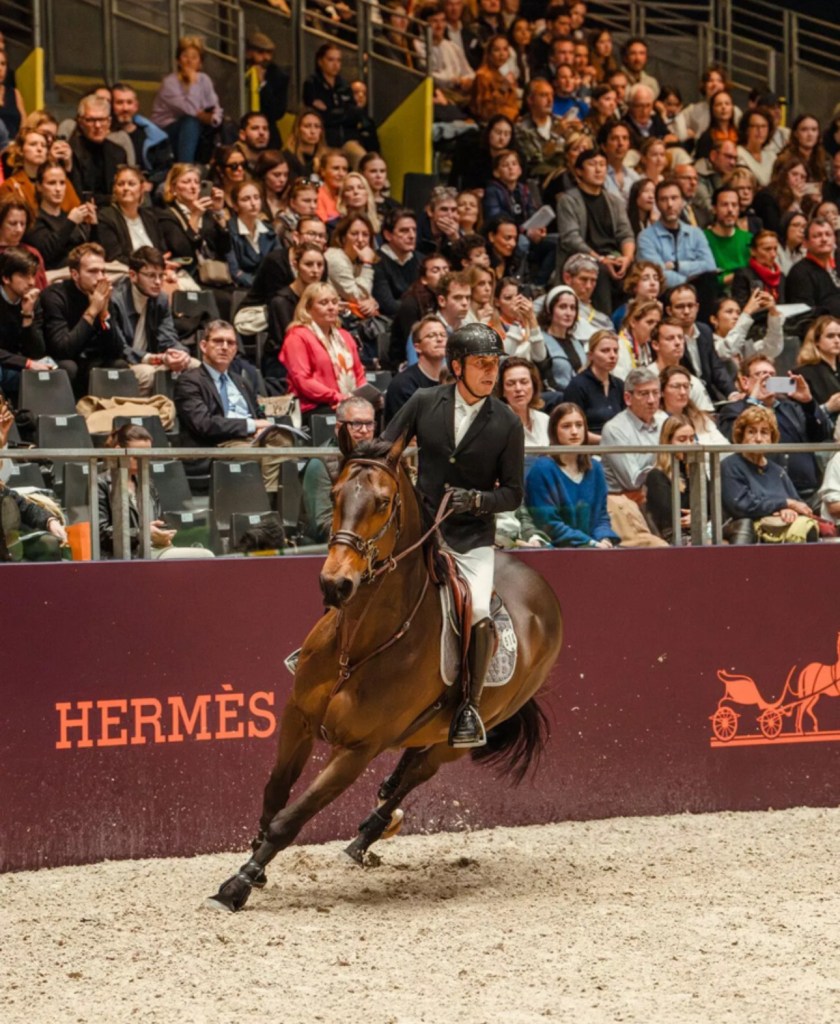
Hermès keeps one foot in the riding arena through sponsorships like the Saut Hermès show-jumping competition in Paris. The annual event, launched in 2010, allows the house to celebrate horses publicly , even as its product focus shifts toward fashion .
Despite these shifts, Hermès has not completely uncoupled itself from the equestrian world, at least not in image and ethos. The company still celebrates its horsey heritage in symbolic ways and insists it remains core to the brand’s soul. Every spring in Paris, Hermès hosts the Saut Hermès, a high-profile show-jumping event at the Grand Palais, where top riders compete under the Hermès banner . The jumps and arena decor are branded with the Hermès logo and iconic carriage motif, and the house invites VIP clients to experience the thrill of equestrian sport up close. “At Hermès, the horse is our first client,” former CEO Jean-Louis Dumas famously said, a quote the company still likes to repeat . At this year’s Saut Hermès, Chloé Nobécourt, Hermès’ director of equestrian métier, emphasized that the “historic equestrian spirit endures” at the house . She pointed out that Hermès continues to make all its saddles by hand, to measure, prioritizing the comfort of horse and rider above all . This bespoke saddle workshop, located just a few kilometers from the Grand Palais, is a living link to 1837 where it all began. In the private Hermès museum in Paris (once Emile Hermès’ office), the company preserves priceless artifacts of the “golden age of the horse” , from bejeweled 19th-century saddles to antique carriage fittings, and invites its designers to draw inspiration from them . In these ways, Hermès consciously keeps its connection to the equestrian tradition alive, at least as a wellspring of inspiration and a marketing touchstone.
However, inspiration and image are one thing; actual practice is another. The modern Hermès is a global luxury behemoth with billions in revenue, 300+ boutiques, and 16 product categories spanning from silk ties to surfboards. Equestrian goods today represent a tiny sliver of that empire. The house has masterfully “reinvented its equestrian-inspired DNA for current and future designs,” as one fashion writer put it, across everything from handbags to home décor . For example, Hermès recently released the Arçon and Petite Course handbags, which riff on saddle shapes and even take their names from riding terminology . The Fall/Winter 2023 runway collection featured riding boots and jockey silks as fashion, not actual riding gear . This speaks to a broader trend: “equestrian chic” is perpetually in vogue (from Dior’s Saddle bags to Gucci’s horsebit loafers ), but it’s often more about aesthetic than equestrianism itself. As a PurseBlog commentary wryly noted, “equestrianism as a sport appears to have largely lost its charm [to luxury brands]…the hobby with its mud and sweat isn’t as glamorous as simply wearing knee-high boots.” For Hermès, leaning into that horse-inspired style has been enormously successful, yet it underscores the irony that the real horse world has become a backdrop, not the focus.
In an ideal scenario, Hermès can maintain both: the panache of its equestrian heritage and the profit of its diversified luxury business. The brand certainly strives to project such balance. It wants the handbag buyers to feel the aura of timeless craftsmanship (anchored in its saddle-making past), and it wants the equestrians to believe that somewhere under the mountain of Birkin orders, the horse is still revered. And to an extent, both are true. Hermès rightly highlights that its artisans use the same saddle stitch on a $10,000 Birkin as on a bespoke saddle, the implication being that every product meets the standard a horseman would expect. The company’s marketing often romanticizes the horse-human connection and the virtues of patience, skill, and tradition that come from the riding arena. This storytelling is not just smoke and mirrors; it genuinely influences the creative process at Hermès. Designers still visit the archives to study historical harnesses and equine motifs, ensuring new collections “draw energy and ideas” from that rich past . The recently appointed creative director, Nadège Vanhee-Cybulski, has even said her vision of Hermès involves “a return to its equestrian roots” in spirit, if not literally in product lineup .
For devotees of the house who are also passionate riders, there is comfort in these gestures , but also an undercurrent of concern. As one such Hermès fan observed, “I respect the evolution of any luxury house, but it’s admittedly disheartening to see Hermès, a brand born from the saddle, gradually retreat from its equestrian foundation.” The worry is that as generations pass, Hermès could become a brand that merely references horses in prints and logos, without actively engaging in the riding world in any meaningful way. The phase-out of riding boots and attire is, to these observers, a red flag. Will Hermès one day cease making saddles altogether if that métier falls below a certain profit threshold? Or will it always keep a foot in the stirrup, no matter how small, as a matter of principle and pride? The company’s own statements give hope that the latter is true. Axel Dumas, the sixth-generation family CEO, often emphasizes that Hermès is “guided by its values and origin story” even as it grows. The family ownership (unlike many rivals that are conglomerate-owned) likely helps maintain a long-term view, one that values heritage and brand image over short-term gains. In practice, that means Hermès is unlikely to ever fully abandon the horse that carried it this far. The equestrian métier may not be a cash cow (pun intended), but it is the cornerstone of Hermès’ identity.
In the end, the story of Hermès is the story of a house that managed to transform authentic craft heritage into global luxury appeal. Its journey from harnesses to handbags is a case study in balancing tradition with innovation. The brand’s modern identity may be dominated by fashion accessories like the Birkin bag, yet the echo of hooves is never far away, be it in a handbag’s design, an annual horse show, or the memories of a time when Hermès literally outfitted the nobility on horseback. For the loyal equestrian clientele and heritage purists, it is somewhat bittersweet to see the focus shift so heavily to lifestyle and status symbols. But they can take heart that Hermès has not forgotten its roots entirely. Every stitch on an Hermès bag, every gleaming buckle, every silk print of a cavalry scene is a quiet tribute to where it all began. As the brand moves forward, those passionate about equestrianism and luxury alike will be watching, hoping Hermès finds room to honor “the spirit of where it all began” even as it gallops ahead. After all, a truly great house can grow and change with the times, without letting go of the reins that guide its legacy.




 Champagne Confessions
Leave a comment